The EPD Is the New Certificate of Origin
As carbon transparency becomes a prerequisite for trade, procurement, and finance, Environmental Product Declarations (EPDs) are emerging as the new certificate of origin in the global low-carbon economy
For two centuries, the certificate of origin has been the document that decided whether goods cleared: at what tariff, under which preferential agreement, into which market. Dry, procedural, easy to dismiss as paperwork. Also, in commercial substance, the document the deal turned on.
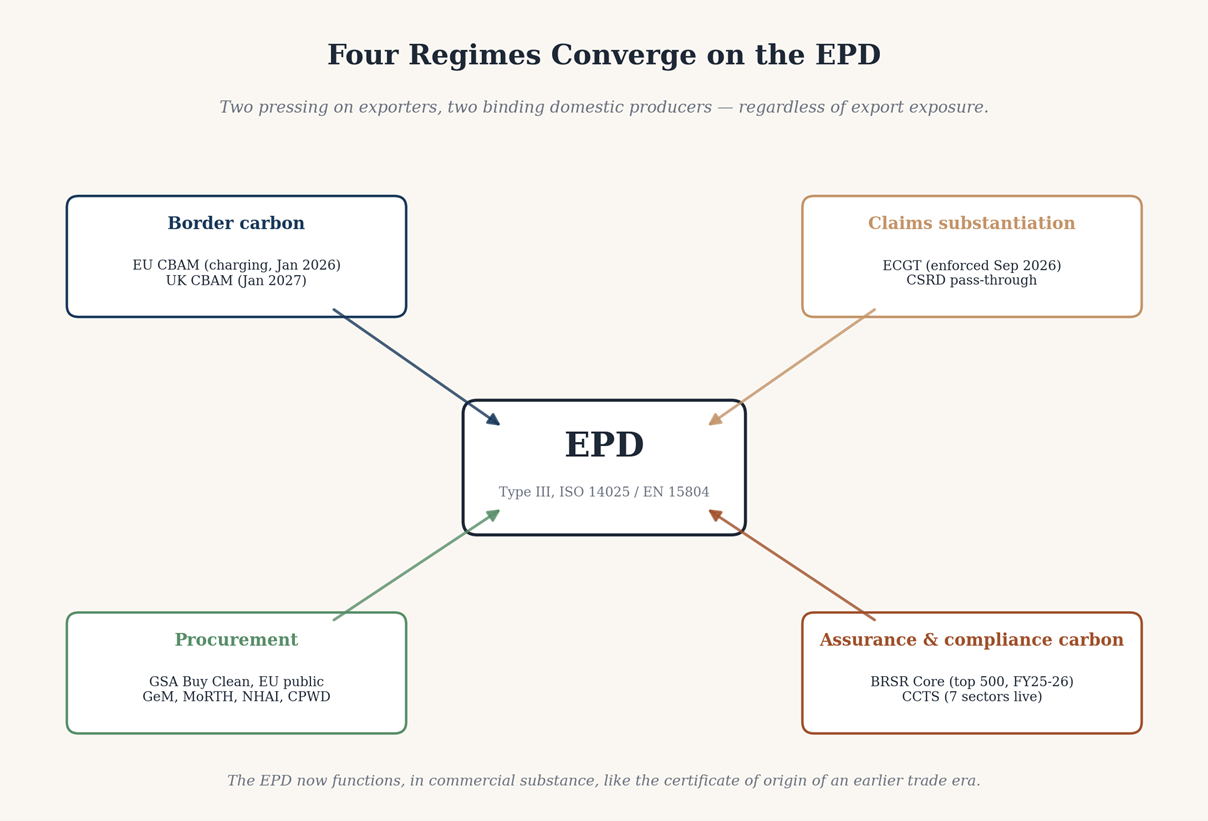
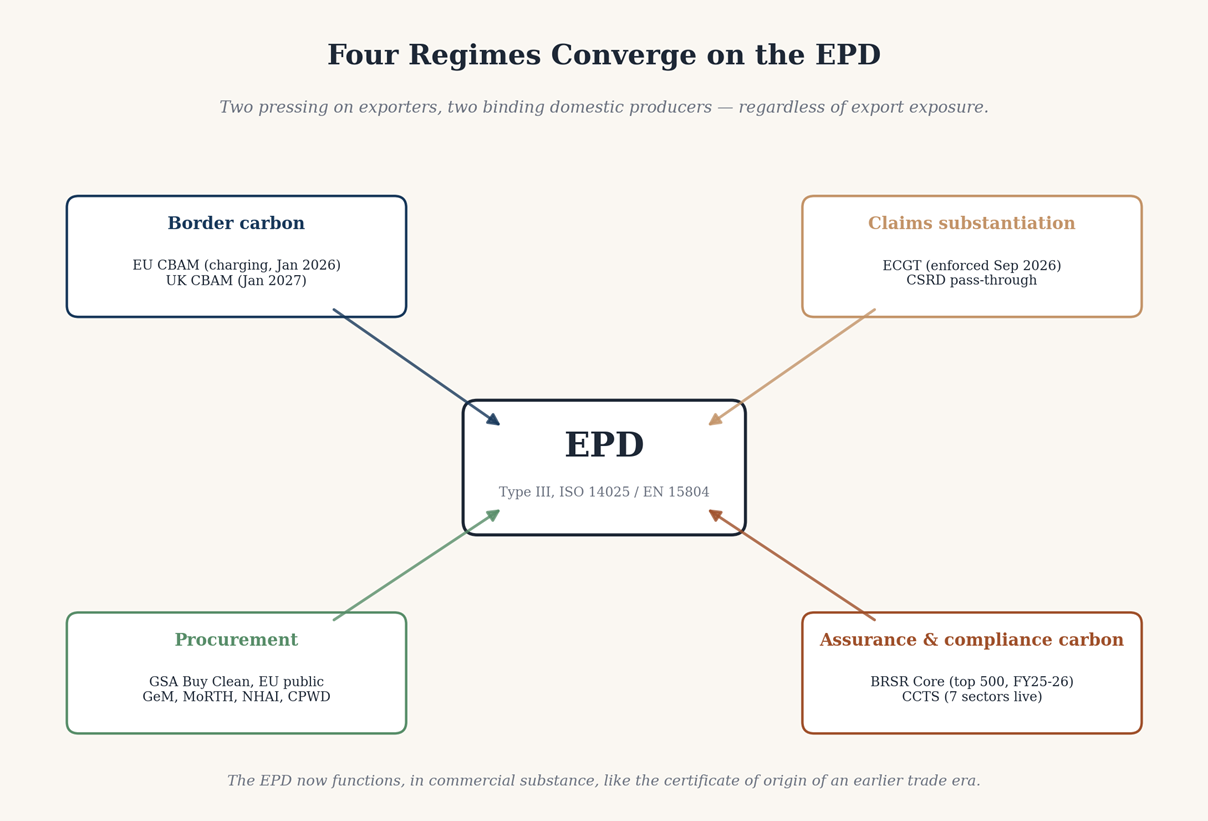
The Environmental Product Declaration is now playing that role for embodied carbon. Four regulatory and commercial shifts have converged in 2026 to put it at the centre of how industrial goods are sold, specified, financed, and assured. Two press on exporters. Two bind domestic producers regardless of export exposure.
For firms in cement, steel, aluminium, insulation, textiles, batteries, and construction products, the question is no longer whether to produce an EPD. It is how fast.
Four Regimes Converge on One Document
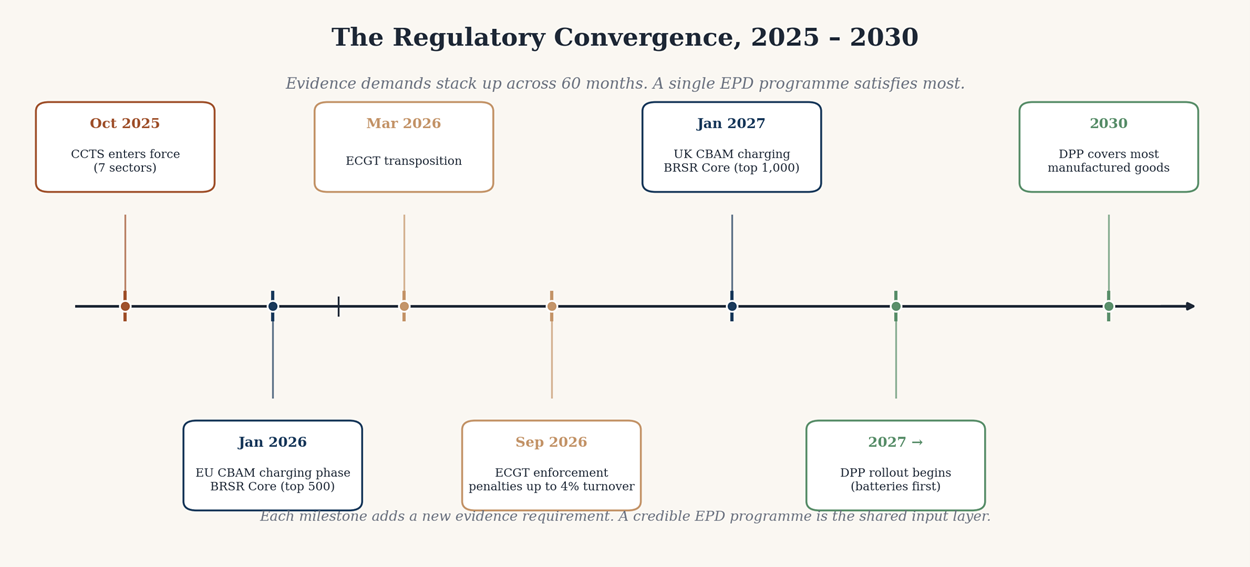
- Border carbon. EU CBAM entered its charging phase on 1 January 2026. Importers of cement, steel, aluminium, fertiliser, hydrogen, and electricity must buy certificates equal to embedded emissions. Absent verified data, defaults calibrated to the worst-performing 10% of installations apply, often the gap between a viable contract and a loss-making one. UK CBAM follows in January 2027 on the same evidence base. As with the certificate of origin, the EPD now sets the tariff line.
- Claims substantiation. The EU’s ECGT Directive (2024/825) transposes in March 2026 and enforces from September, with penalties reaching 4% of turnover. It prohibits unsubstantiated “eco-friendly” labels and offset-based “carbon neutral” product claims. Type III EPDs (third-party verified, life-cycle-based, programme-registered) are among the few forms of evidence that satisfy the standard cleanly. CSRD pass-through extends the same burden into Indian suppliers’ data systems.
- Procurement. GSA Buy Clean specifies product-level environmental data for concrete, steel, asphalt, and flat glass. Nordic, Dutch, German, French, and Danish public procurement have moved the same way. Apple, Microsoft, and Walmart have migrated supplier carbon from scorecards into binding bid specs. In India, GeM, MoRTH, NHAI, and CPWD reference embodied-carbon criteria in various procurement tenders; IGBC, GRIHA, and LEED India award specification credits for EPD-backed materials. Without the document, the specification is closed to the bidder.
- Assurance and compliance carbon. SEBI’s BRSR Core mandates independent assurance for the top 500 listed companies in FY 2025-26, extending to the top 1,000 from FY 2026-27. Scope 3 Category 1 is typically 40 to 70% of a manufacturer’s footprint, and the audit turns on whether supplier data withstands reasonable-assurance testing under ICAI SSAE 3000. In parallel, CCTS is live across seven energy-intensive sectors: aluminium, cement, chlor-alkali, pulp and paper, refining, petrochemicals, and textiles. Iron, steel, and fertiliser are next. CCTS uses the same measurement architecture as an EPD.
The certificate of origin determined whether goods cleared. The EPD now determines the terms on which they clear: tariff, specification, finance.
One Dataset, a Dozen Regimes: The Indian Multiplier
For Indian producers, a single defensible LCA dataset generates compliant evidence for roughly a dozen parallel regimes (domestic, export, and financial), each of which would otherwise require its own methodology, verifier, and audit trail.
The certificate of origin earned its place in trade because one stamp opened a dozen doors. The EPD has the same property.
Three Indian specifics worth noting. BIS has adopted ISO 14025 and 14067, and the revitalised Eco Mark accepts EPD-backed evidence. The National Green Hydrogen Mission’s verified gCO₂/kg-H₂ intensity is, in substance, a single-issue EPD. And the ACC battery PLI factors sustainability explicitly into its evaluation.
Next Comes the Digital Product Passport
The EU’s Ecodesign for Sustainable Products Regulation rolls out the DPP from 2027: batteries first, then textiles, construction products, electronics, furniture, and most manufactured goods by 2030.
Firms with mature EPD programmes will populate DPP schemas from existing data structures. Firms without will be building product-level life-cycle data at scale under regulatory deadline, while their customers are notified that goods without a DPP cannot be placed on the EU market.
If the EPD is the certificate of origin of the carbon era, the DPP is its digital successor, and the ledger it sits on is being built now.
The Arantree Process: How We Build EPD Programmes
Standing up an EPD programme is cross-functional: engineering, procurement, sustainability, finance, IT. Most teams have the parts. Few have the workflow.
The leverage point is structural. Every regime that lands on the document (CBAM, BRSR Core, CCTS, ECGT, procurement bids, lender term sheets, the DPP) pulls from the same underlying life-cycle inventory. Build that inventory once, to assurance grade, and one piece of work serves a dozen filings. Build it twice, separately, and the cost compounds while the data drifts.
Arantree’s engagements unfold in five phases.
Phase 1. Strategic scoping
We map where EPDs unlock the most value: priority SKUs ranked by export exposure, procurement pipeline, premium-SKU potential, and Scope 3 materiality. We select Product Category Rules and the right programme operator (EPD International, IBU, UL Environment, or a BIS-aligned Indian programme) based on target markets and buyer specifications.
Output: a board-ready EPD roadmap with sequencing, costs, and ROI per SKU.
Phase 2. Data architecture and life-cycle inventory
We stand up the data infrastructure once and use it everywhere. Foreground inventory is built from facility metering, BOM systems, and structured supplier engagement. Background data is drawn from ecoinvent and EF-compliant datasets. Quality, provenance, and uncertainty are documented to ISO 14040/14044, and to a level that withstands SSAE 3000 reasonable-assurance audit.
Output: a single product-level dataset that simultaneously serves CBAM declarations, BRSR Core assurance, CCTS reporting, customer disclosure, and DPP population.
Phase 3. Modelling, hotspot analysis, and decarbonisation roadmap
Full life-cycle impact assessment in SimaPro, openLCA, or GaBi, using EF 3.1 and ReCiPe 2016 characterisation. Hotspot analysis identifies the three to five levers that actually move the GWP needle: clinker factor, electricity mix, scrap or recycled content, transport mode, end-of-life allocation.
Output: a quantified decarbonisation roadmap with a marginal abatement cost curve and an internal carbon price the CFO can use for capex screening.
Phase 4. Verification and programme registration
Coordination with the chosen programme operator and an accredited third-party verifier. Independent review of the LCA report, the EPD document, and the underlying data. Resolution of verifier queries. Final registration.
Output: a programme-registered, publicly available EPD with QR-coded verification, citable in tenders, term sheets, and customer disclosures.
Phase 5. Commercial activation
The phase most programmes leave on the table. We translate the EPD into the four assets that pay back the cost of building it: sustainability-linked finance term sheets, premium-SKU positioning and bid documents, an internal carbon price for capex decisions, and DPP-ready data architecture for the 2027 deadlines.
Output: the EPD operating as commercial infrastructure, not as a filing.
For firms in cement, steel, aluminium, textiles, batteries, and construction products, we typically begin with the Phase 1 scoping engagement on its own. It produces a board-ready roadmap, a priority-SKU shortlist, and a compliance integration plan. Enough to commit to the full programme, or to pause, on the basis of evidence rather than instinct. Reach out via the comments or Substack messaging.
The Window Is Open. The First Mover Sets the Benchmark.
Where CBAM, the ECGT, CSRD, BRSR Core, CCTS, and procurement policy intersect, the EPD has become what the certificate of origin was to twentieth-century trade: the document that determines whether goods clear, at what tariff, into which market, under what terms.
For companies in covered sectors, obtaining one is a question of when, not whether. The firms that answer “now” define the benchmark. The customs stamp of the carbon era is theirs to issue first.
If you work in Indian industry, sustainability, procurement, or export markets, what are the real barriers you see on the ground to standing up an EPD programme? Reply or comment below.