EPD in Digital Infrastructure Supply Chains
EPD is an increasingly common tool to drive carbon transparency in digital infrastructure supply chains. Read on to find out what EPDs are, why they matter for data center suppliers, and how suppliers can be prepared.
For years, sustainability in the data center sector has been primarily measured by operational metrics such as power usage effectiveness (PUE) and water usage effectiveness (WUE). However, that is changing rapidly as the sector begins to account for embodied emissions.
The key moment for this arrived in July 2024 when the Governing Body of the iMasons Climate Accord — consisting of hyperscalers such as AWS, Google, Meta, Microsoft, and infrastructure partners such as Digital Realty and Schneider Electric — published an open letter[1] calling on all suppliers serving data centers to support greater transparency in supply chain emissions. At the heart of this call was one instrument: the Environmental Product Declaration (EPD), which is a tool to measure and report the embodied environmental footprint of a product; in this case that of the equipment and buildings that make up the data center.
What is an EPD?
An Environmental Product Declaration (EPD) is a standardised, third-party verified document that reports a product’s environmental impacts across its full lifecycle, based on a Life Cycle Assessment (LCA). It is defined under ISO 14025 as a Type III environmental declaration, meaning it quantifies environmental performance rather than making qualitative ‘green’ claims.
An EPD covers multiple impact categories such as, but not limited to:
- Climate change (GWP)
- Water consumption and water stress
- Resource depletion (minerals, fossil fuels)
- Acidification and eutrophication
- Ozone depletion
- Land use changes
Each EPD is produced in accordance with a Product Category Rule (PCR) — a rulebook that specifies how the LCA must be conducted and reported for a given product category, ensuring results are comparable across manufacturers.
The Carbon Math driving the EPD requirement
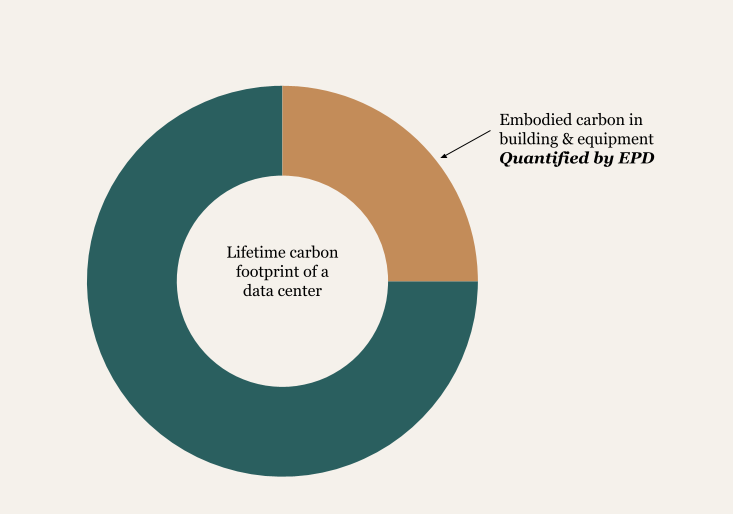
One of the key insights to have emerged in recent years is that data centers have equally high Scope-3 emissions as Scope-2, even though Scope 2 (primarily purchased energy) is more visible. The key factor driving this is the embodied carbon of the data center equipment, which is high due to short replacement cycles (4–7 years) of IT components and the carbon intensity of electronics manufacturing. A Schneider Electric Study[2], estimates the contribution of embodied emissions, specifically from manufacturing stage, as 20-30% of lifetime carbon footprint of a data center. See detailed breakdown in the infographic below.

The strategic implication for data center operators based on the above data is that without verified product-level carbon data from their suppliers, they cannot accurately quantify, report, or reduce their Scope 3 footprint. The EPD is the mechanism that makes supplier-level carbon data credible, available and comparable for informing their procurement and operational practices.
Path Forward for Suppliers
Based on industry & regulatory trends, we see that the EPD requirement will go from a voluntary to a mandatory requirement for participating in procurement processes in the near future (5-10 years). What this means is that though the EPD requirement is still in its nascent stages, early movers will have the competitive advantage by conducting an LCA of their products now to identify and address environmental hotspots in their manufacturing before EPD starts to influence procurement decisions strongly.
If you are a data center equipment supplier, especially high emission ones such as servers, networking gear, power and cooling equipment, consider commissioning a LCA of your products as a priority.
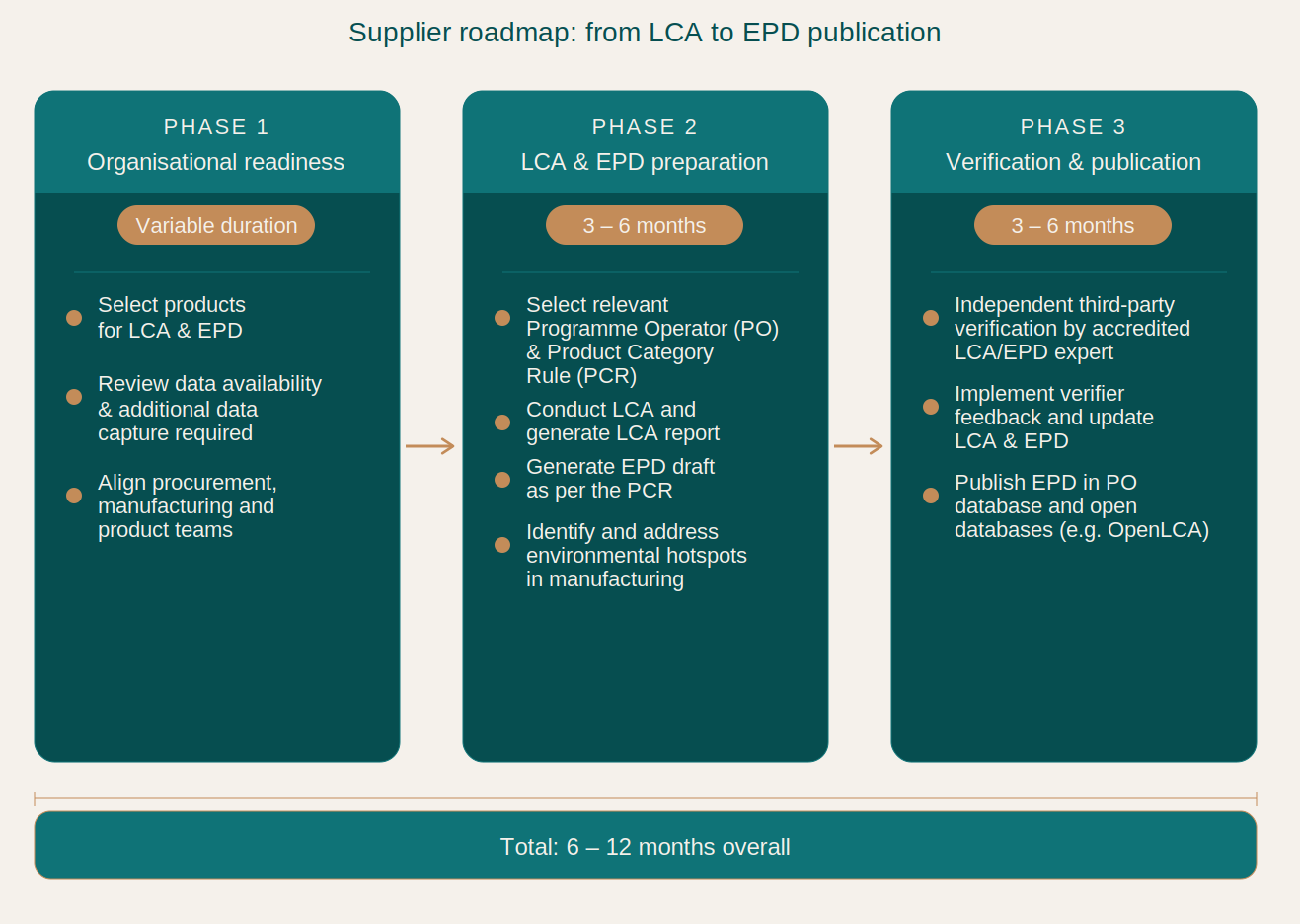
The LCA process can commonly take between 3-6 months, depending on data availability and product complexity. If it is your organisation’s very first LCA, allow additional time to build your organisation’s readiness for LCA, especially in terms of data capture & collection. Identify the relevant EPD programme operator (PO), such as EPD international or PEP Ecopassport and the relevant Product Category Rule (PCR) to inform the framework for the LCA.
Upon completion of LCA, generate an EPD for the product and seek independent verification from an LCA/EPD expert. The verified EPD can then be published in the programme operator’s database and also in open databases such as OpenLCA and structured in machine-readable formats aligned with eclass and ISO 22057. This total post-LCA process can take anywhere between 3-6 months.
The supplier roadmap is visualised below: