Digital Product Passports: A New Baseline for Trust
The EU is turning product-level traceability into a condition of market access. For Indian suppliers, the passport itself is the easy part. The hard part is the assessment behind it.
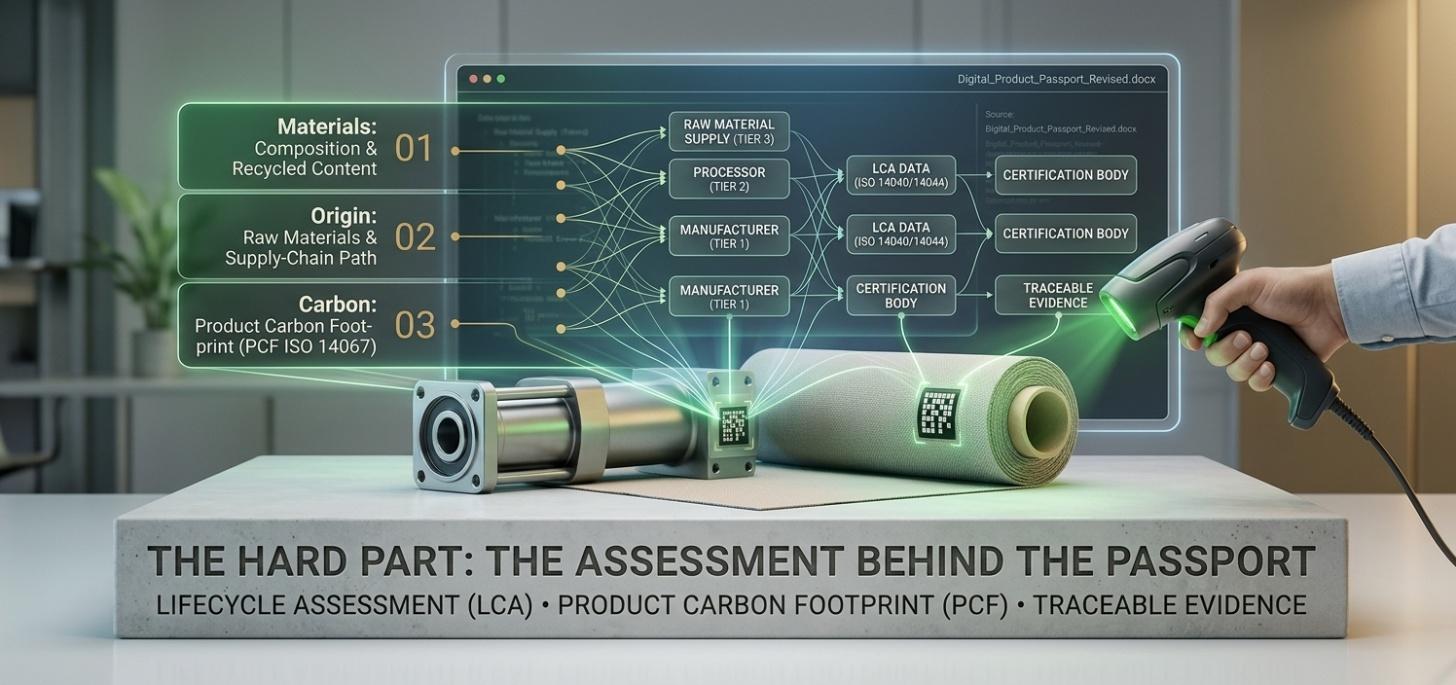
Years before any regulator asked for it, Patagonia began publishing the journey of its products. Through the Footprint Chronicles[1], a customer could follow a jacket back through the sewing factory and the textile mill, and see what the company knew, and what it admitted it did not yet know, about the environmental cost of making it. Sheep Inc., a London knitwear brand, later stitched the idea into the garment itself: an NFC-enabled tag links each piece to the farm its wool came from, the people who made it and product-level impact data.[2] Neither company waited for a rulebook. Transparency was a commercial choice, and it made their claims harder to imitate in a market full of vague language about responsible sourcing.
From 2027, for a growing list of products sold in the European Union, that choice starts to disappear. The first mandatory model arrives on 18 February 2027, when specified electric-vehicle, light-transport and rechargeable industrial batteries placed on the EU market must carry a battery passport.[3] Under the Ecodesign for Sustainable Products Regulation (ESPR), steel, textiles, aluminium, tyres, furniture and electronics are moving through the same pipeline. What Patagonia and Sheep Inc. did as a differentiator is becoming, category by category, a condition of market access.
The decisive shift is not the tag on the product. It is the requirement to connect product claims to evidence that can be checked across the value chain, and the single hardest piece of that evidence to produce is a product's environmental performance. That is why the sensible starting point for any supplier is not software or data architecture. It is the life cycle assessment (LCA) and product carbon footprint (PCF) work that sits underneath the passport.
What is a Digital Product Passport?
A Digital Product Passport (DPP) is a persistent digital identity record linked to a physical product, batch or product model. The data carrier, whether a QR code, NFC chip, RFID tag or another machine-readable identifier, is only the access point; the EU has deliberately not fixed a single format. The passport is the structured record behind it, combining information from manufacturers, component makers, material suppliers, testing bodies, repair networks and recyclers.
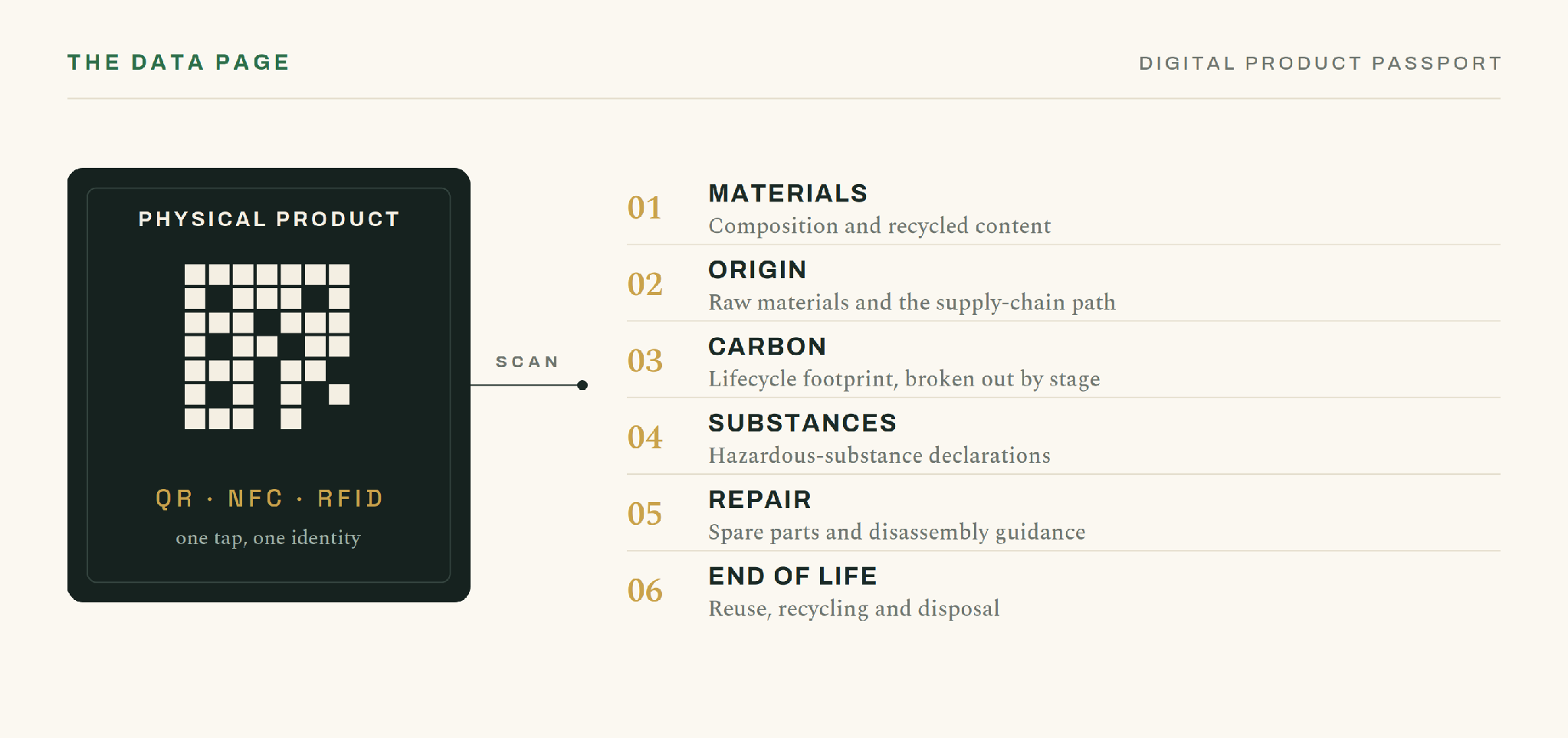
Image 1: A DPP links a physical product, through a data carrier, to structured information across six domains: materials, origin and chain of custody, environmental performance, substances and compliance, use and repair, and end of life.
The figure above captures what a useful passport must answer: what the product is made of, where its materials came from and through which supplier tiers they moved, what its carbon footprint and wider lifecycle impacts are, which restricted substances and certifications apply, how it should be maintained and repaired, and what should happen to it after use. Not every user sees the same information. Consumer-facing fields may be public, while commercially sensitive data can be restricted to authorised actors, and the record can stay active after the first sale as the product is repaired, resold or recycled.
A passport does not make a product sustainable by itself. It makes the information behind the product structured, comparable and easier to verify, so that buyers can assess suppliers, recyclers can identify recovery options and regulators can check whether claims are supported.
A requirement spreading beyond Brussels
The EU framework is the most developed. The ESPR, Regulation (EU) 2024/1781[4], entered into force in July 2024 and creates the framework for product-specific ecodesign and information requirements, with the DPP as the principal mechanism for making that information available. The obligations arrive through delegated acts for individual product groups. The Commission is required to establish the central DPP registry by 19 July 2026, batteries provide the first mandatory passport from February 2027, and the 2025-2030 working plan[5] sets indicative adoption dates: 2026 for iron and steel; 2027 for textiles and apparel, aluminium and tyres; 2028 for furniture; and 2029 for mattresses and horizontal electronics measures. These are dates for adopting EU measures, not automatic dates on which every covered product must already carry a live passport.
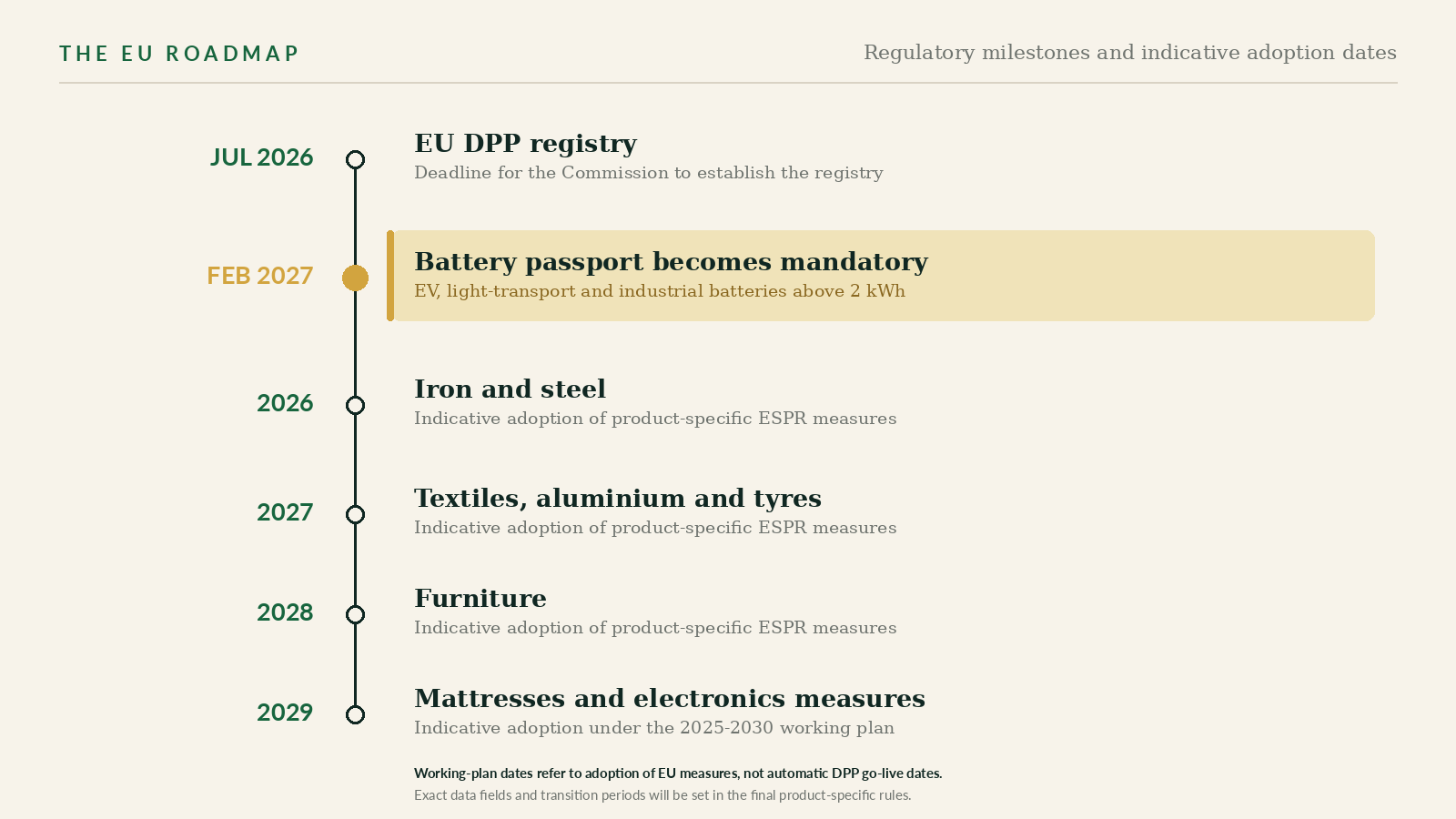
Image 2: EU DPP milestones and indicative working-plan dates. Final data fields and transition periods will be set in product-specific rules.
But the direction is no longer only European. France's anti-waste law (AGEC) has required companies to give consumers product-level environmental and circularity information since before the ESPR existed, and French authorities have begun enforcing it with financial penalties. Japan is running technical development projects for product passports, using plastics as an early test case. China is building out product carbon-footprint rules for key exports, which points towards the same product-level environmental data that a passport carries. In the United States, state-level proposals such as New York's fashion supply-chain legislation push in a similar direction for apparel. India's own digital EPR portals and product traceability systems are not equivalent to the EU DPP, but they show domestic regulators moving towards the same logic of product-level, digitally reported data. The creation of ISO/IEC JTC 5[6] for digital product passports in 2026 confirms that interoperability is now a global standards question rather than a purely European one.
For an exporter, the practical conclusion is that preparing product-level evidence once, well, is likely to serve several regimes, while preparing for none of them will eventually close doors in more than one market.
The assessment behind the passport: LCA and PCF
Here is the uncomfortable truth about DPP preparation in 2026: for most product groups, nobody yet knows the final data fields. Those will be fixed in delegated acts that are still being drafted. Investing heavily now in data platforms, governance structures or passport software means building to a specification that does not exist.
One requirement, however, appears in every version of the rules and every credible precedent: environmental performance data, with the product carbon footprint at its core. The Battery Regulation already requires a carbon footprint declaration calculated under a prescribed methodology. Research on early DPP systems reaches the same conclusion from the other direction: environmental impacts posted on a passport necessitate a life cycle assessment, because impact figures without a defined method, system boundary and data inventory behind them cannot be verified or compared. Reviews of DPP implementations across batteries, textiles, automotive, construction and electronics likewise find material composition and carbon footprint at the centre of every case.
An LCA quantifies a product's impacts across its life cycle, from raw material extraction through manufacturing, use and end of life, under international standards (ISO 14040/14044). A PCF is the carbon-specific version of the same exercise (ISO 14067), and EU product rules are converging on the related Product Environmental Footprint methods. This is precisely the work most suppliers have not done at product level. A company may know its annual electricity use and still be unable to allocate emissions credibly to one product; it may know its immediate supplier but not the origin of a critical material several tiers upstream.
The same exercise also carries the circularity measures a passport needs. Recycled content, material recoverability and end-of-life characteristics rest on the same product-level inventory of materials and processes that an LCA forces a company to build. In other words, LCA and PCF are not just one data field among many. They are the assessment that generates the material and process map on which most other passport fields depend, and they are the fields that take months, not weeks, to produce credibly. Whatever the delegated acts finally say, this work will not be wasted.
What it means for Indian suppliers
An Indian textile mill, metal processor, component maker or material supplier may never issue the final passport. European buyers will nevertheless need upstream information to populate it, and the first requests are likely to concern material composition, recycled content, manufacturing location, restricted substances and, above all, product-level carbon data.
The first bottleneck is usually not software. It is whether the requested data can be traced to a reliable source, expressed at the right product level and supported with evidence. The commercial pressure will vary by sector:
- Textiles and apparel — material composition, recycled content, chemical compliance, durability and fibre-to-garment traceability are likely to become central.
- Steel and aluminium — grade, production route, recycled content, origin and product-level carbon intensity will be important procurement data.
- Components and electronics — materials, critical substances, spare parts, repairability and recovery routes will matter.
In each case, the supplier who can hand a buyer a defensible product carbon footprint and a documented bill of materials will answer most of the early questionnaire before it arrives.
A nearer-term prize: the UK FTA
For an Indian exporter, the passport's most immediate payoff may have nothing to do with the ESPR at all. It sits in the India-UK Comprehensive Economic and Trade Agreement, whose rules of origin took effect on 15 July 2026 and remove UK tariffs of up to 12 per cent on textiles and apparel and up to 16 per cent on leather and footwear.[7] Those savings are not automatic. A shipment earns the lower duty only if the exporter can prove the goods originate in India, and the proof is documentary.
The origin tests turn on exactly the data a passport already assembles. A product qualifies either through a change in tariff classification, which requires the bill of materials with the HS code of every input, or through a qualifying value content threshold, typically 35 per cent under the build-up method, which requires the value and origin of originating versus non-originating materials. Both tests ask the same upstream questions a DPP is built to answer: what the product is made of, where each material came from, and through which processing steps. Under CETA the exporter self-certifies origin and must retain the supporting records for five years to survive a verification check.
This is where many MSME exporters leave money on the table. The tariff line is duty-free on paper, but assembling a defensible origin file — input classifications, supplier declarations, value build-ups and process records — is enough paperwork that smaller firms either skip the claim and pay the full duty, or file a thin declaration that fails when customs tests it. A product-level record built for the passport does most of this work in advance. The same bill of materials, origin data and process map that populates a DPP is the evidence base a rules-of-origin claim needs, so one exercise serves a compliance obligation arriving later and a cash saving available now.
Path forward for suppliers
Companies should not treat a DPP as a last-minute QR-code exercise, but nor should they build elaborate digital systems against rules that are not yet written. The sequence that survives regulatory uncertainty starts with the assessment: choose one defined product family, map its materials and processes, run the PCF or LCA, and identify where the data and evidence gaps sit across supplier tiers. Piloting an actual passport comes later, once the product-specific rules fix the data fields.
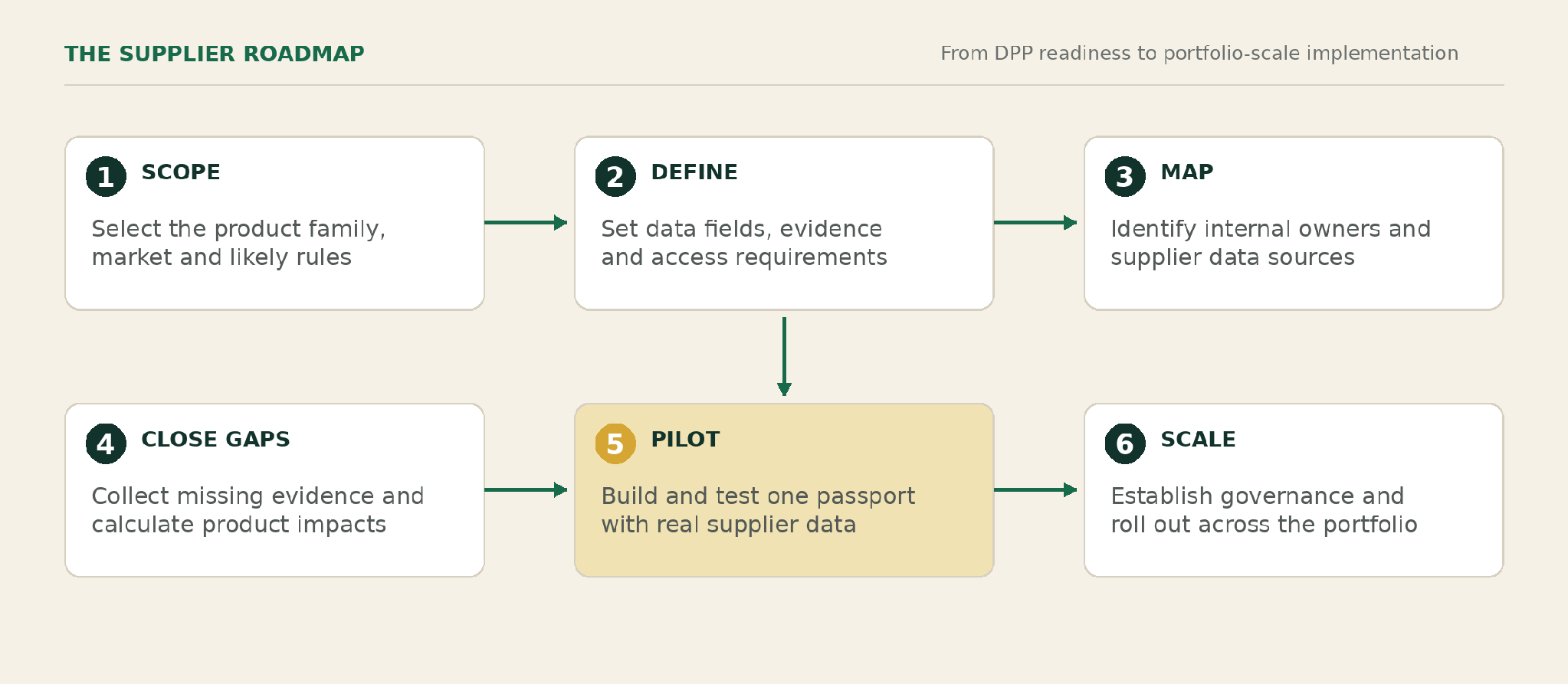
Image 3: A practical programme begins with one defined product family. The early stages — scoping, data mapping and gap-filling — are valuable regardless of how the final EU rules are written; the pilot stage waits for product-specific requirements.
A focused readiness and footprint assessment for one product family can typically be completed in three to six months. Starting narrow allows a company to find its data gaps before they are reproduced across the portfolio.
How Arantree can help
Arantree helps manufacturers prepare the evidence base a passport will draw on, focusing on the two pieces of work that make sense before product-specific rules are final:
- Readiness and applicability assessment — which regulations and buyer requirements are likely to apply to your product categories and markets, on what timeline, and where your current data and documentation stand against them.
- Environmental assessment — product carbon footprint and life cycle assessment aligned with ISO 14067 and ISO 14040/14044, together with the circularity indicators — recycled content, material recoverability and end-of-life characteristics — that draw on the same product-level inventory.
If your products sit anywhere in the ESPR pipeline, the practical first step is clear: commission a product carbon footprint for one product family this year. It is the one requirement that appears in every version of the rules, it takes months to do credibly, and it produces the material map that everything else in the passport builds on. Write to us at info@arantree.com, tell us the product family, and we will come back with a scoped assessment plan, the data you will need from your suppliers, and a realistic timeline, before your buyers put the same questions to you with a deadline attached.
References
[1] Patagonia, The Footprint Chronicles.
[2] Sheep Inc., Connected Dot product traceability information.
[3] Regulation (EU) 2023/1542 concerning batteries and waste batteries.
[5] European Commission, Ecodesign for Sustainable Products and Energy Labelling Working Plan 2025-2030.
[6] ISO/IEC JTC 5, Digital Product Passport — scope and committee information.